
In the global race for rare earth elements (REEs) and critical minerals, the conversation often focuses on exploration and mining. Yet the decisive point of strategic leverage is neither discovery nor extraction — it is processing.
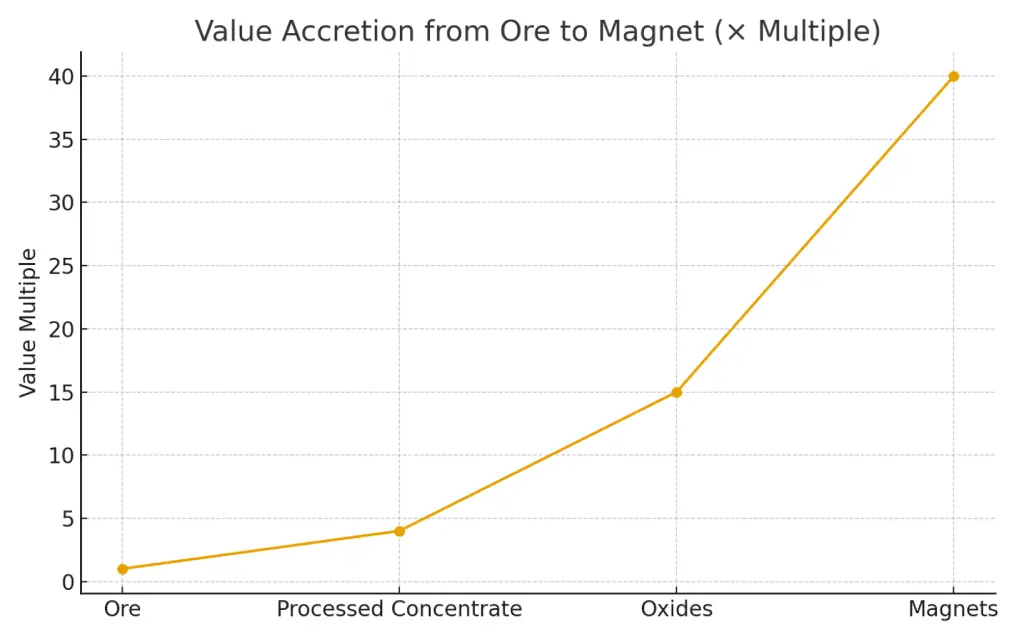
Processing determines who controls value addition, who shapes downstream industries, and ultimately who holds geopolitical leverage in the clean-energy era.
Mining gives access. Processing gives leverage. Refining gives dominance.
And in today’s supply chains, processing has emerged as the real fulcrum of power.
1. Why Processing Sits At The Centre Of Strategic Control
Mineral processing is the stage where ore becomes high-value concentrate. This step governs:
- Feedstock quality for refineries
- Recovery efficiency and economics
- Operational viability of downstream magnets, batteries, and alloys
- Environmental footprint of the entire value chain
Key processes include crushing, grinding, gravity separation, magnetic separation, flotation, electrostatic separation, and hydrometallurgical pre-treatment.
Nations without processing capability remain trapped at the lowest end of the value chain — exporting raw minerals and importing high-value oxides, metals, and magnets at a premium.
This is precisely the gap that companies such as GeoExpOre, with deep domain expertise in mineral processing and flowsheet development, have long highlighted as India’s largest structural opportunity.
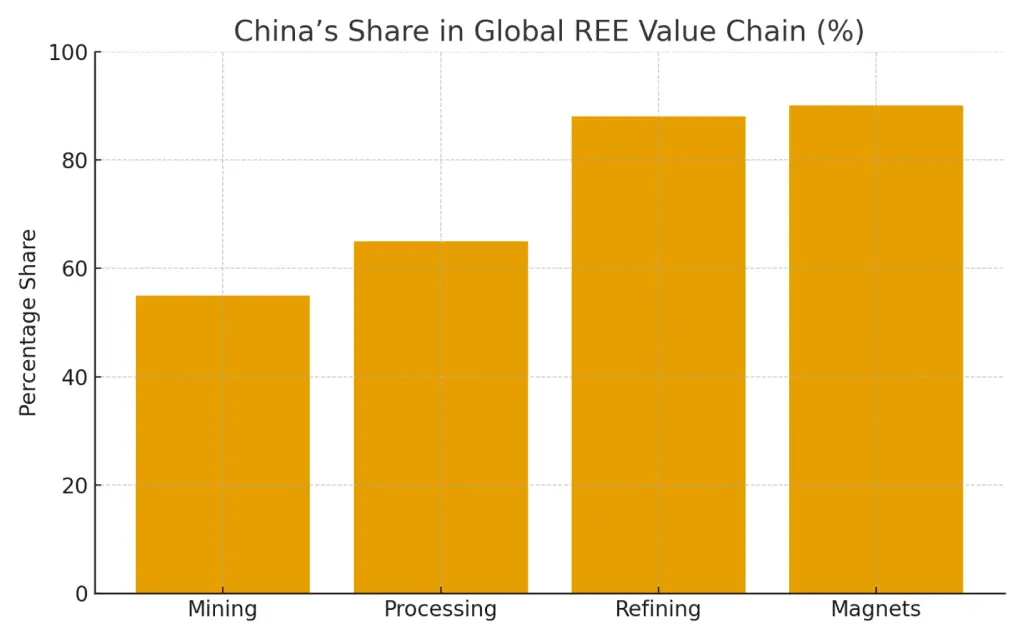
2. China’s Dominance Was Built On Processing — Not Just Refining
China’s supremacy today is widely acknowledged, but the world often forgets how it was achieved.
China did not start by dominating refining.
It started by dominating beneficiation and separation technologies.
China’s strategic play included:
- Decades of investment in REE beneficiation, separation, and chemical processing
- Locating processing hubs near mines to control supply
- Innovating flowsheets for complex monazite, xenotime, and clay deposits
- Centralising processing under long-term industrial policy
- Vertical integration into magnets and advanced materials
This dominance is cemented not by ore availability — but by processing mastery.
3. Why The West, India, Japan & Australia Are Still Behind
Despite massive funding and political urgency, most countries face bottlenecks in:
- Complex mineralogy with no standardised flowsheets
- Absence of pilot-scale processing plants
- Limited REE processing talent
- High cost of reagents, waste treatment, and compliance
- Unproven refining economics without secure concentrate supply
This is exactly where AI-driven platforms like EarthScience.AI are beginning to play a transformative role, offering simulation-based optimisation, predictive modeling, metallurgy-informed AI workflows, and digital-twin capabilities that can reduce processing cost, reagent consumption, and energy footprint.
4. India’s Strategic Window: Build The Processing Base
India has strong geological potential across REEs, titanium minerals, graphite, vanadium, and lithium-bearing pegmatites. But India’s true competitive edge will come only from processing.
India must invest aggressively in:
- REE beneficiation and separation plants
- Hydrometallurgy technologies (SX, IX, leaching circuits)
- Processing hubs near mining clusters
- AI-based flowsheet optimisation (EarthScience.AI)
- Large-scale pilot testing facilities
- Advanced mineralogical and metallurgical R&D
- Private-sector processing specialists like GeoExpOre
GeoExpOre’s on-ground capabilities in REE, graphite, beach-sand, base-metal, and refractory-ore processing — combined with AI-powered optimisation from EarthScience.AI — represent exactly the type of integrated solution India needs to accelerate processing independence.
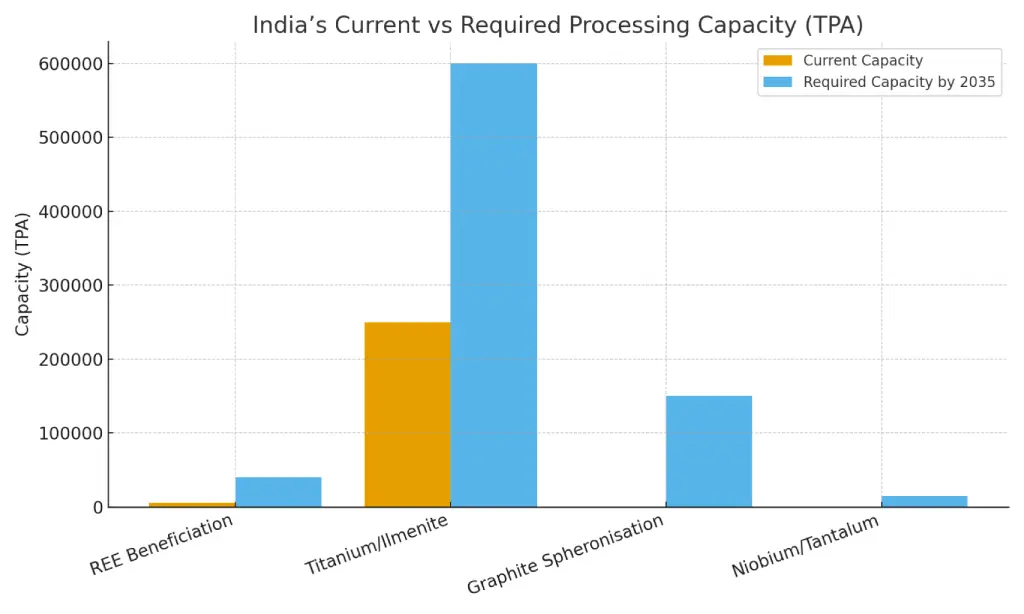
5. Visualising India’s Processing Capacity Gap
India’s processing capacity must expand significantly to meet future demand for EVs, defence, electronics, and space.
6. The Future Belongs To Nations That Process, Not Just Mine
Processing will determine:
- Who controls battery supply chains
- Who manufactures defence-grade materials
- Who dominates EV, aerospace, and robotics industries
- Who achieves technological sovereignty
The critical minerals race will not be won by who finds the most deposits.
It will be won by who can process them — efficiently, sustainably, and at scale.
Mining gives material. Processing gives leverage. Refining gives dominance.
GeoExpOre and EarthScience.AI collectively represent the new class of processing and AI intelligence capabilities that nations must adopt to remain competitive.
“In critical minerals, whoever controls the processing controls the leverage — and whoever controls the leverage controls the future.”