
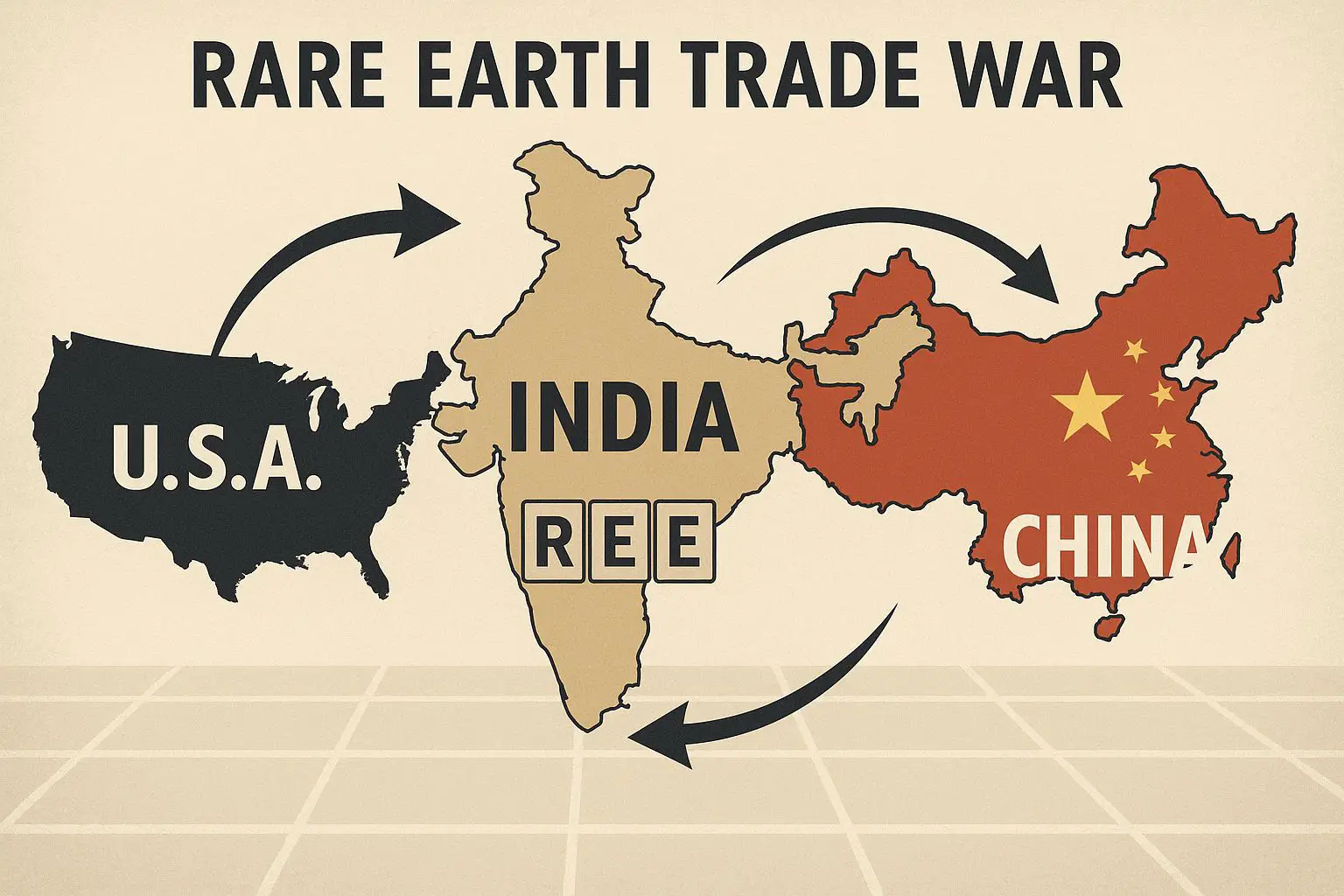
When two powers fight, the collateral can reach far beyond their borders. The ongoing trade confrontation between the United States and China over rare earth elements (REEs) is no exception. China, wielding deep dominance over rare earth refining, magnet manufacturing, and technology, is increasingly using those supply chains as strategic leverage. The fallout isn’t just for the U.S. and China; it has serious implications for third players—among them, India.
For India—whose ambitions include becoming a high‑tech manufacturing hub, a global EV and renewable leader, and a strategic stronghold in the Indo-Pacific—this rare earth squeeze represents both a risk and a wake-up call. In this blog, we walk through sector-by-sector impacts, diagnose India’s vulnerabilities, and argue that this moment is a rare chance to rethink our mineral, industrial, and geopolitical strategy.
Setting the Stage: What China’s Export Controls Mean
China has long held a near-monopoly in refining, separation, and magnet manufacturing, even though it is not the only country with physical rare earth reserves. In 2025, Beijing expanded its export control regime to include strict licensing for magnets, rare earths with even trace Chinese content (≥0.1%), recycling equipment, and even foreign firms using Chinese mining or processing tech. These measures are explicitly pitched as security moves. Applications tied to defense or semiconductors will face heavier scrutiny or be denied. The timing is not accidental: the controls enhance China’s leverage ahead of high-stakes trade talks with the U.S. In short: what once was a commodity trade has morphed into a geopolitical straitjacket. Countries that depended on cheap, reliable REE supply are now wrestling with regulatory risk, delays, and the specter of supply being deliberately cut (or conditioned) by Beijing.
India’s Starting Point: Reserves, Dependency, and Gaps
Reserves vs Capability
India is not resource-poor in this space. It holds roughly 6.9 million tonnes of rare earth oxides in reserves (among the top in the world). But here’s the catch: having the ore is one thing; processing, refining, separation, alloy manufacturing, and magnet fabrication are entirely different value chains—technically complex, capital intensive, and environmentally sensitive. India lags in those steps.
Import Reliance and Strategic Weakness
India currently imports nearly all of its permanent magnets and downstream rare earth products. Before the recent escalation, even sourcing raw REE oxides faced bureaucratic and licensing delays—importers had to queue weeks for procurement, navigate authentication via the DGFT, and submit to Chinese export licensing terms. Further, Chinese exporters have increasingly demanded from buyers guarantees that heavy rare earth magnets will not be re-exported or used for defense applications as a precondition for releasing shipments. That is a political and sovereignty intrusion on trade. So India’s current posture is: large reserves but low conversion capacity, and heavy import dependence for the value-added chain. This is exactly what makes us vulnerable in a world where rare earth supply is becoming a geopolitical weapon.
- Sectoral Impacts: Across-the-Board Exposure
- Defense & Strategic Tech: A Hole in the Armour
Rare earths are integral to defense hardware—radars, missile guidance systems, stealth coatings, electronic warfare systems, jet engines, precision munitions—virtually everything that differentiates modern militaries. China’s controls are aimed at cutting off defense users from its supply chain. India, which aspires to strategic autonomy, has long struggled with foreign dependence in defense systems. The rare earth squeeze exacerbates this. If deliveries of high-performance magnets or specialty alloys get delayed or blocked, project timelines in weapons systems or avionics could slip. In the short term, risk to defence projects is real. In the longer term, India must accelerate its indigenization not just in electronics and design, but in critical mineral supply chains. Defense readiness cannot be contingent on diplomatic goodwill from another power.
Electronics, Semiconductors & High Tech: Cost Shock + Supply Risk
In consumer electronics and industrial devices, rare earths play silent but essential roles: speaker magnets, camera optics, phosphors in displays, catalysts, sensors, and more. Even when they’re not front-and-center, they are input chokepoints. As China tightens export of even trace REE content, global supply is being stressed. For Indian electronics and IoT hardware firms, the implications are:
- input inflation as costs of REE-based components rise;
- lead-time disruption as sourcing new vendors in non-Chinese geographies takes time; and
- technology risk, with firms needing to redesign to reduce REE content or substitute alternative materials. If India wants to compete globally in electronics manufacturing (as a “China + 1”), this supply shock could blunt the advantage unless we move fast to secure alternate or domestic supply.
Automobiles & Electric Vehicles (EVs): Magnet Risk in the Motor
The EV sector is perhaps the most exposed. Permanent magnets made from neodymium-iron-boron (NdFeB) or variants with heavy rare earths (e.g., dysprosium for heat resilience) are central to high-efficiency motors. Without strong rare earth magnet supply, motors get larger, costlier, and less efficient. Indian automakers already sounded the alarm after earlier export restrictions in 2025, warning that their magnet inventories could last only weeks in the face of supply delays. With Beijing demanding trade guarantees (e.g., non‑reexport to the U.S.) for magnet shipments to India, automakers could be held hostage by foreign bureaucratic terms. If magnet supply is choked, Indian EV rollout timelines and cost targets (already tight) could suffer delays or price upticks—weakening adoption, capital flows, and investor confidence.
Renewable Energy & Clean Tech: A Delicate Balancing Act
Wind turbines—in particular, direct-drive turbines—rely heavily on permanent-magnet generators. Rare earth magnets are integral to those designs. If magnet or rare earth supply is constrained, India’s wind build-out could slow, or force use of less efficient generator designs. Solar PV is less directly dependent on rare earths, but solar equipment, inverters, and tracking systems may use rare earth-based components. And the broader green transition is tightly linked: battery storage, grid technologies, and other clean infrastructure rely on critical minerals (not just REEs, but lithium, cobalt, etc.), which face geopolitical stress too. Thus, the rare earth war threatens to raise the cost of India’s climate ambitions, making clean energy rollout more fragile.
Industrial & Manufacturing Base: Hidden Exposures
Rare earths aren’t confined to high-tech sectors. They’re used in catalysts, glass polishing, ceramics, specialized alloys, aerospace components, and industrial tools. Even seemingly mature manufacturing clusters (machinery, tools, instrumentation) can be affected if supply of REE‑derived inputs is squeezed. When small disruptions in upstream inputs cascade, they can derail entire production chains. Indian manufacturing that hopes for resilience must now internalize rare earth supply risk as part of its design.
Short-Term Shock, Medium-Term Adjustment, Long-Term Strategy
Short-Term: Supply Squeeze & Price Shock
India is already feeling the pinch. Importers report delayed clearances, longer procurement cycles, and inefficient supply logistics. Some component suppliers had cushion stocks for only a few weeks. Globally, rare earth prices—especially for magnet-critical elements like neodymium and dysprosium—have surged. That adds inflationary pressure to price-sensitive industries. India’s immediate need is to ensure continuity: using stockpiles, prioritizing critical projects (defense, essential EV lines), and re-arranging trade flows to less risky suppliers (if available). But these are stopgaps.
Medium-Term: Building Alternatives and Redundancies
- Diversify supply: India must look beyond China. Australia, Vietnam, the U.S., and African nations are potential sources. But what matters is not just the raw mine, but the midstream capacity (refining, separation, magnet making).
- Alternative technologies: Motor designs that reduce or eliminate rare-earth magnets (e.g., reluctance or induction motors) should be prioritized where feasible, even at some efficiency trade-off.
- Recycling & circular economy: End-of-life electronics, wind-farms, and EV motors contain rare earths. Building domestic recycling capacity is hard, but in the medium term, this becomes not just optional but strategic.
- Strategic reserves: The government should consider creating a strategic reserve for critical minerals (magnet reserve, rare earth oxide buffer) to ride out supply disruptions.
- Emergency procurement and bilateral deals: In critical sectors (defense, national infrastructure), India may need standby agreements or guaranteed offtake deals with friendly nations or miners.
Long-Term: Rewriting the Value Chain
Here is where the real shift must happen. India cannot remain a passive consumer of rare earth value-added products. It must become a player in the chain.
- Integrated mines-to-magnets build-out: Auctioning and developing REE-rich blocks is a start. But the leap is building refineries, separation plants, alloy plants, and magnet lines domestically. A national scheme to support magnet manufacturing and upstream refining can kickstart capacity over the next seven years if it is executed with clear milestones and procurement linkages.
- Public–private and international partnerships: India’s own technology base is limited for advanced separation and magnet metallurgy. The way forward is JV models with nations that have expertise (Japan, U.S., Australia, Korea). Government can de-risk private investment with guarantees, minimum offtake, and strategic subsidies.
- Holistic policy alignment: This isn’t just an issue for Mines Ministry. A whole-of-government alignment—across defense, heavy industry, electronics, EVs, renewable energy, and infrastructure—is needed. Trade policy, foreign policy, and industrial policy must cohesively support a critical mineral strategy.
- Environmental and social safeguards: Rare earth mining and refining can be environmentally damaging. If India ramps up capacity without stringent oversight, it risks pushback and litigation. Best practices and green processing technologies must be part of the plan from day one.
- Geopolitics and supply-chain diplomacy: India must leverage its position in broader critical mineral initiatives—the Mineral Security Partnership, Quad frameworks, and bilateral offtake deals—with an eye to co-investment, tech transfer, and supply assurance. Aligning with countries that fear China’s leverage gives India both opportunities and obligations.
The Risks of Inaction (and Delayed Response)
If India fails to treat this as a systemic challenge, the consequences extend beyond sectoral pain:
- Eroded competitiveness: As input costs and delays rise, Indian manufacturing and exporting may lose their price edge.
- Strategic subordination: In defense and high-tech, India could again find itself hostage to external supply.
- Missed green goals: Delays or cost overruns in renewable and EV hardware could slow climate transitions and undermine investor confidence.
- Geo‑political leverage over India: Allowing external demands to condition our supply would set a dangerous precedent.
What India Must Do: A Strategic Prescription
- Fast‑track national support for rare earth magnet production and upstream refining; ensure predictable policy and secure budgetary commitment. The scheme must be commercially viable, not symbolic.
- Create a strategic mineral buffer for defense, EVs, and key clean‑tech sectors—an Indian “rare earth reserve.”
- Prioritize high‑impact sectors—defense, telecom, EVs, wind/solar—and channel early domestic magnet production toward these via public procurement.
- Unlock and de‑risk mining/processing investment—streamline approvals, reduce royalties on rare earth byproducts in mixed ore mining, and ensure infrastructure access.
- Forge JV partnerships and technology transfer agreements internationally (Japan, U.S., Australia, Korea).
- Push R&D on low‑ or non‑REE materials (magnet alternatives, new composite materials) as hedges.
- Strengthen recycling infrastructure—collect e‑waste, plan decommissioning of old clean‑tech hardware, and recover rare earths at scale.
- Leverage geopolitics—deepen our role in MSP, Quad, and supply‑chain coalitions; position as a stable, trustworthy node in critical minerals.
- Monitor environmental and social permissions rigorously—scale must not come at the cost of communities or ecosystems.
- Be assertive diplomatically—resist overreach, negotiate favorable trade and offtake pacts, and avoid passive acquiescence.
A Closing Verdict: Crisis as Catalyst
The rare earth trade war between the U.S. and China is not a remote specialty dispute—it is a strategic realignment of global supply chains, where minerals become instruments of power. For India, this conflict strikes at the heart of our defense, tech, energy, and industrial ambitions. But crisis also breeds opportunity. If India seizes this moment to break the fragility of its supply chains, to build domestic rare-earth capability and align policy with purpose, we may end up stronger. The road is hard—technology gaps, capital intensity, and environmental constraints—but the alternative is dependence, compromise, and risk.
In an era that demands strategic autonomy, India’s success will be measured not just in exports or GDP growth, but in its capacity to control the materials that power its future technologies. The rare earth war is a warning shot—and India must not be found unprepared.