
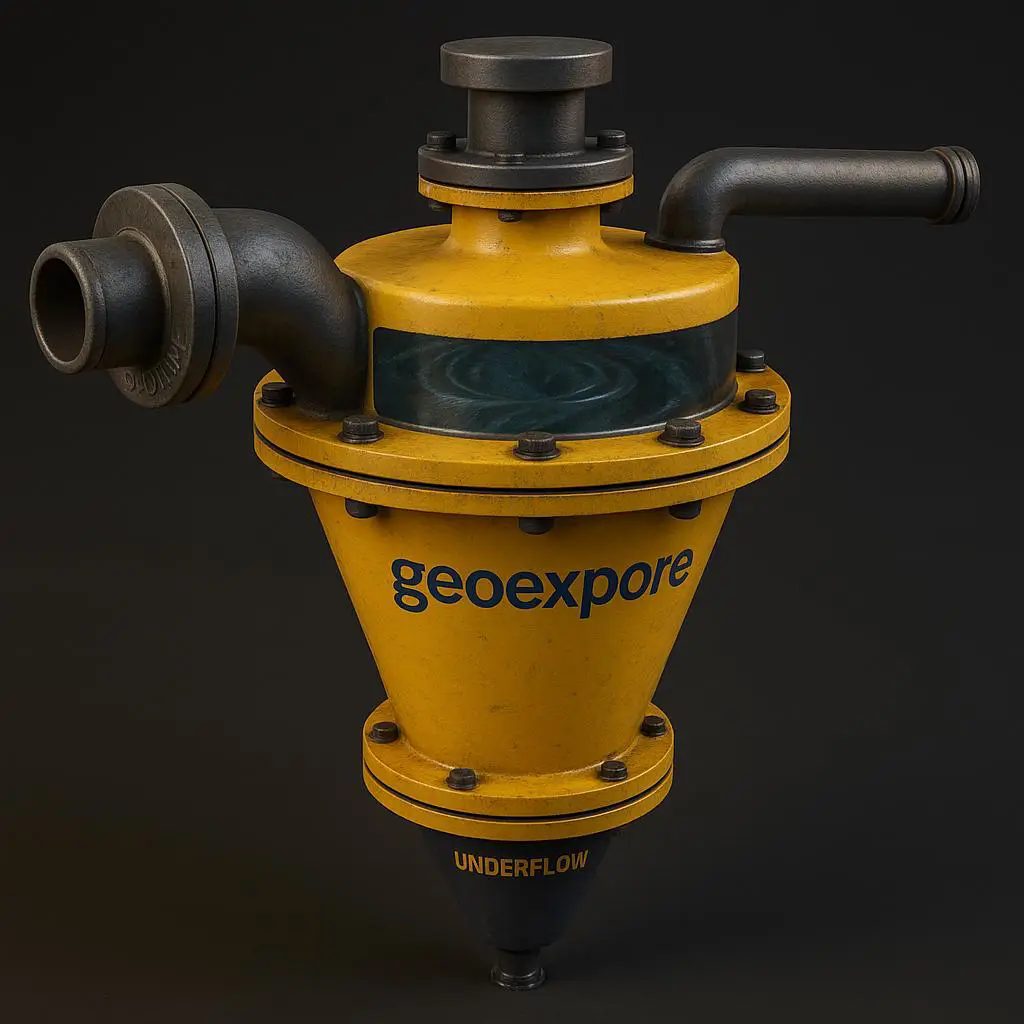
Hydrocyclones (or simply “cyclones” in mineral processing) are widely used in ore beneficiation and comminution circuits to classify particles by size and density using centrifugal forces. They are key in the following areas:
- Classification: Separating coarse from fine particles. The coarse underflow is typically returned to grinding, while the fine overflow goes to downstream processes such as flotation.
- Desliming: Removing very fine (slimes) particles that interfere with downstream processes.
- Dewatering: Concentrating slurry and eliminating excess water before tailings disposal or further processing.
- Recovery and classification: For example, separating sulphide particles (pyrite) from tailings.
Because of their compact size, lack of moving parts, relatively low cost, and flexibility, hydrocyclones are preferred in many mineral processing flowsheets.
Historical Perspective
Origins and Early Adoption
- Hydrocyclones date back to at least the late 1930s. In fact, a key reference notes their development at the Dutch State Mines around 1939.
- After WWII, as grinding circuits and plant sizes scaled up, hydrocyclones began replacing rake and spiral classifiers because they required less floor space and offered higher capacity at lower capital cost.
- Despite their simplicity, early designs already showed significant impact: they allowed classification over a broad particle-size range (e.g., 5–500 µm).
Evolution of Design
Over time, manufacturers experimented with various parameters to improve performance:
- Geometrical modifications: cone angles, apex sizes, vortex-finder penetration, feed inlet design, etc.
- Materials of construction: to handle wear, cyclones have been built with rubber, polyurethane, ceramics, stainless steel, etc.
- Understanding limitations: For instance, in dense mineral systems like magnetite, density differences can skew cut-points (i.e., “corrected” cut size depends on mineral density).
Even with decades of use, historic operational data suggest that separation efficiencies (i.e., how sharply particles are split) often remained in the 45–65% range.
Effectiveness and Efficiency in Mineral Processing
Let’s break this into what “effectiveness” and “efficiency” mean in the context of hydrocyclones, and how they are evaluated.
What Determines Effectiveness
- Cut Size (d50): The particle diameter where there is a 50% chance of reporting to overflow vs underflow.
- Sharpness of Separation: How steep the classification curve is — i.e., how cleanly particles near the cut-size are split.
- Split Ratio / Water Split: How much water goes to overflow vs underflow — this affects dilution, downstream load, etc.
- Throughput / Capacity: How much slurry the cyclone can handle at a given performance.
- Wear and Maintenance: Cyclone liners erode; maintenance must ensure the geometry remains close to design to keep performance.
What Determines Efficiency
Efficiency here largely refers to energy, process, and operational efficiency:
- Energy Use: The pump energy needed to maintain pressure and flow.
- Water Efficiency: Minimizing fines bypass, reducing unnecessary water in underflow or overflow.
- Operational Efficiency: How well the cyclone cluster performs over time; detecting individual underperforming cyclones is critical.
- Process Efficiency: Better classification reduces overgrinding, ensures optimal feed to flotation, improves recovery, and reduces losses.
Challenges and Trade-offs
- Pressure Sensitivity: Cyclone performance depends strongly on feed pressure (or pump speed). Higher pressure → finer cut, but increases wear and energy demand.
- Feed Properties: Feed density, particle size distribution, turbulence, and slurry rheology affect performance.
- Wear Dynamics: Erosion of vortex finder, cone walls, and spigots shifts the cut size and reduces sharpness.
- Instrumentation Limitations: Traditionally, individual cyclones in a cluster weren’t well-monitored; the measured parameters (pressure, density) are often “cluster-level,” masking poor-performing units.
Latest Trends and Innovations
The hydrocyclone technology is still evolving. Here are some of the most important recent developments:
- New Hydrocyclone Geometries
-
- Curved Bottom Hydrocyclone: This new design that supports higher unit capacity, coarser cut sizes, and reduced fines bypass.
- Such designs are especially useful in modern circuits where coarse-particle flotation is gaining importance (e.g., coarse flotation of liberated particles).
- Smart Monitoring & Real-Time Control
-
- Integration of IoT sensors to monitor pressure, flow, density, and other parameters in real time.
- Use of external sensors (e.g., acoustic or vibration) to detect poor performance in individual cyclones. For instance, systems have been developed to detect coarse particles in overflow by mounting sensors on the outer pipe. c
- Predictive maintenance: detecting wear (e.g., erosion of vortex finder) before it causes a drop in classification efficiency.
- Advanced Modeling for Performance Prediction
- Data-driven models: Few labs developed a performance model for hydrocyclones processing iron-ore fines, mapping cut-size and efficiency curves based on experimental data.
- Computational Fluid Dynamics (CFD): Used to simulate internal flow, optimize geometry, and reduce energy losses.
- Materials & Wear-Resistant Designs
- Use of abrasion-resistant ceramics and polymers to extend lifetimes.
- Modular designs: easier replacement of liners, or modular clusters that can be scaled or maintained without entire shutdown.
- Enhanced maintenance features: e.g., hydrocyclone has weep holes to signal liner failure early.
- Sustainability & Water Efficiency
- Because water scarcity and environmental regulation are growing concerns, modern dewatering hydrocyclones aim to reduce water consumption significantly (some claims up to 40% less than conventional methods).
- Energy-efficient designs contribute to reducing CO₂ emissions
- Market Growth & Adoption Trends
- The hydrocyclone market is expanding rapidly, driven by mining demand and environmental regulations.
- There’s a shift toward customized, application-specific hydrocyclones rather than “one-size-fits-all” models.
Challenges & Considerations Going Forward
While advances are significant, there are still some challenges and considerations:
- Instrument Integration Costs: Retrofitting old plants with smart hydrocyclones or sensors may require capital.
- Model Accuracy: Data-driven or CFD models require quality feed data; deviations in ore properties affect their predictive accuracy.
- Wear vs Performance: Even with advanced materials, managing erosion remains critical; liner replacement or maintenance is non-trivial.
- Operational Expertise: Operators need training to interpret real-time sensor data and optimize operation accordingly.
- Sustainability Trade-Offs: While water and energy use are reduced, there’s still a balance between high throughput and cut sharpness that must be managed.
Case Studies: Real-World Impact of Advancements in Hydrocyclone Technology
Case Study 1: Iron Ore Beneficiation Plant – India
Challenge:
An iron ore plant processing hematite fines struggled with:
- Excessive fines bypass to the underflow
- High recirculating loads in the ball mill (220–250%)
- Inconsistent cyclone cut sizes due to fluctuating feed pressure
Intervention:
The plant upgraded from 1970s-style 250 mm cyclones to a modern cluster with:
- High-efficiency vortex finder and inlet geometry
- Wear-resistant polyurethane liners
- Automated pressure control valves
Results:
- Cut size reduced: from ~150 μm to 110 μm
- Milling energy reduced: 8–10%
- Recovery improved: +3.5% Fe in concentrate
- Reduced downtime: liner life increased from 4 months to 9 months
Takeaway:
Upgrading cyclone geometry and incorporating modern liners dramatically improved stability, classification sharpness, and power consumption.
Case Study 2: Copper–Gold Concentrator – South America
Challenge:
A large grinding/flotation circuit faced:
- High variability in cyclone performance
- Inability to detect single-cyclone malfunction in a 16-unit cluster
- Flotation grade variation due to coarse particles in overflow
Intervention:
The plant deployed real-time cyclone monitoring sensors (acoustic particle detection, pressure transducers, and overflow PSD monitoring).
Results:
- Reduction in coarse material in overflow: 35%
- Stabilized flotation feed P80: from ±24 µm variation to ±6 µm
- Increased recovery: +2% Cu and +1 g/t Au
- Early detection: plugged spigots and roping events identified in <30 seconds
Takeaway:
Smart monitoring transformed cyclone operation from reactive to predictive, stabilizing the entire concentrator.
Case Study 3: Coal Preparation Plant – Australia
Challenge:
The plant required high-efficiency desliming (removal of <30 µm particles) before flotation.
Legacy cyclones had:
- Poor separation efficiency at low particle sizes
- High water consumption
- Frequent roping due to variable feed solids
Intervention:
Adopted new-generation large-diameter dewatering hydrocyclones with:
- Spiral feed inlet
- Extended cone angle
- Underflow regulator
Results:
- Dewatering efficiency improved: cake moisture reduced by 18%
- Water savings: ~25%
- Improved flotation performance due to consistent feed density
- Reduced tailings volume and improved thickener stability
Takeaway:
Modern dewatering cyclone technology directly enhanced plant water efficiency and flotation performance.
Case Study 4: Hard Rock Lithium Plant – Canada
Challenge:
With increasing global lithium demand, the plant needed:
- Coarser classification to feed coarse particle flotation (CPF)
- Reduced slimes (<10 µm), which interfered with spodumene flotation
Intervention:
Installed coarse-cut hydrocyclones designed for:
- Higher mass throughput
- Larger vortex finder
- Curved-bottom geometry for efficient coarse separation
Results:
- Coarse particle recovery improved significantly in CPF
- Fines (<10 µm) to flotation reduced by 40%
- Reduced power usage in grinding circuit (coarser grind target)
- Total lithium recovery improved by ~4%
Takeaway:
Next-generation cyclone designs enable new flowsheet technologies like coarse-particle flotation, improving recovery and reducing energy use.
Case Study 5: Gold Plant – Africa
Challenge:
Operators faced severe cyclone wear due to abrasive quartz ores.
This required frequent shutdowns and inconsistent cyclone geometry.
Intervention:
The plant upgraded to:
- Ceramic-lined cyclones
- Modular cone and apex replacement system
- Real-time liner wear detection (ultrasonic sensor technology)
Results:
- Liner life increased: from 6 weeks to 8 months
- Reduced downtime: 22 fewer shutdowns per year
- Improved cyclone stability → better gravity circuit performance
- Overall plant throughput increased by 6%
Takeaway:
Material innovation (ceramics, modular wear parts) can be as impactful as geometric changes.
Synthesis: What These Case Studies Show
Across these examples, key modern hydrocyclones improvements deliver:
1. Better Process Control
Smart sensors + automated valves = stable cut size, stable mill load.
2. Improved Separation Efficiency
Sharper classification curves → better downstream recoveries.
3. Reduced Energy Consumption
Coarser grind targets and lower recirculating loads reduce mill energy.
4. Maximized Plant Availability
Wear-resistant components and predictive maintenance mean fewer shutdowns.
5. Increased Recovery and Grade
More consistent flotation or gravity concentration performance.
6. Environmental Gains
Lower water consumption, reduced tailings, and better dewatering contribute to
sustainability.
Acknowledgment:
The case studies presented are representative engineering scenarios synthesised from industry trends and published technical literature and learnings from my guru late Prof. T.C Rao. Background information and technological context are drawn from sources including Bradley (1965), Rietema, SME Mineral Processing Plant Design volumes, Multotec technical bulletins, Metso MHC™ hydrocyclone papers, CiDRA CYCLONEtrac™ monitoring papers, JKMRC publications, and various peer-reviewed articles in Minerals Engineering and International Journal of Mineral Processing.
Yerriswamy Pateel, Ph.D
Founder & Director
GeoExpOre Pvt Ltd